McLaren, unlike Ferrari or Lamborghini, won't build an SUV
McLaren's design chief is not into the SUV.
Lamborghini now has one, and Ferrari says it will introduce one by
late 2019 or 2020. But don't expect McLaren to taint its supercar DNA by
giving into the temptation to tap into the hot-selling sport utility vehicle segment.
"I'm not the first person to point out an SUV is neither particularly
sporty or utilitarian," McLaren's chief designer, Dan Parry-Williams, told Top Gear.
"It's not 'everything for a reason,' unless the reason is to clutter up
the streets," referring to a McLaren design mantra ("everything for a
reason", a nod to minimalism and purposefulness in the company's cars).
In other words, they're not going to build one since it doesn't fit with
the mission of the company: to build ultra high-performance sportscars.
(AutoBlog.com)
Showing posts with label mclaren. Show all posts
Showing posts with label mclaren. Show all posts
Tuesday, January 23, 2018

Tuesday, January 16, 2018
A Joint Effort For Speed
Ferrari, BMW lend expertise to Olympic bobsled, skeleton, luge
Motorsports and sliding have plenty in common.
"There's always the link between the Formula One companies, or any motor company, and skeleton and bobsleigh," says Rachel Blackburn, the engineer who has been involved in Britain's skeleton program since 2006 and who used to work for McLaren.
"There's the Ferrari sleds and the BMW sleds ... when we were at McLaren it kind of made a good story," she told Reuters by telephone from her home in Dubai.
That somewhat manufactured rivalry has died down in the years since Sochi, with McLaren no longer involved and Ferrari's presence low key.
But the worlds of grand prix motor racing and sliding sports still have plenty in common.
Bobsled, luge and skeleton are among the fastest of Olympic sports, with bobsleds reaching speeds over 90 mph. Drivers are subjected to gut-wrenching G-forces, and crashes can be fatal.
And then there is the ongoing debate about cost controls, the direction of future rules, preserving a level playing field and obsessive secrecy — all endlessly recurring themes in Formula One.
(AutoBlog.com)
Motorsports and sliding have plenty in common.
"There's always the link between the Formula One companies, or any motor company, and skeleton and bobsleigh," says Rachel Blackburn, the engineer who has been involved in Britain's skeleton program since 2006 and who used to work for McLaren.
"There's the Ferrari sleds and the BMW sleds ... when we were at McLaren it kind of made a good story," she told Reuters by telephone from her home in Dubai.
That somewhat manufactured rivalry has died down in the years since Sochi, with McLaren no longer involved and Ferrari's presence low key.
But the worlds of grand prix motor racing and sliding sports still have plenty in common.
Bobsled, luge and skeleton are among the fastest of Olympic sports, with bobsleds reaching speeds over 90 mph. Drivers are subjected to gut-wrenching G-forces, and crashes can be fatal.
And then there is the ongoing debate about cost controls, the direction of future rules, preserving a level playing field and obsessive secrecy — all endlessly recurring themes in Formula One.
(AutoBlog.com)
Tuesday, October 24, 2017
A Rare Chance To Own A Unicorn From McLaren
This never-registered 1997 McLaren F1 is for sale, if you have the cash
This is the automotive equivalent of being mint in the package.


(AutoBlog.com)
This is the automotive equivalent of being mint in the package.


(AutoBlog.com)
Wednesday, April 26, 2017
Tuesday, January 24, 2017
For The Discerning McLaren Owner
McLaren and Richard Mille unveil new RM 50-03 Split-seconds chronograph priced at $1 million

(4WheelNews.com)

(4WheelNews.com)
Wednesday, January 4, 2017
Who Knew McLaren Catered?
McLaren Sells Catering Division
McLaren, yes that McLaren, has a catering division. Or rather it had a catering division, as it announced just this morning that it sold it.
Absolute Taste, as the catering division was known, was sold to a company called One Event Management, which appears to consist of a catering division of its own, a pub, and a helicopter business
In case you’re actually wondering why the hell McLaren had a catering division, apparently almost 20 years ago McLaren realized they had a bunch of employees and no internal catering division to feed them, according to the Absolute Taste web site:
“Awwwwwwww MAN! I’m sad, their food rocks,” one McLaren source who requested deep anonymity told us.
(Jalopnik.com)
McLaren, yes that McLaren, has a catering division. Or rather it had a catering division, as it announced just this morning that it sold it.
Absolute Taste, as the catering division was known, was sold to a company called One Event Management, which appears to consist of a catering division of its own, a pub, and a helicopter business
In case you’re actually wondering why the hell McLaren had a catering division, apparently almost 20 years ago McLaren realized they had a bunch of employees and no internal catering division to feed them, according to the Absolute Taste web site:
Back in 1997 Lyndy Redding and Ron Dennis formed Absolute Taste in order to provide hospitality to the McLaren F1 team.
Nearly 20 years on, the Absolute Taste team still travel the world providing fresh food and VIP hospitality to the McLaren Honda Formula 1 Team, its partners and guests throughout the grand prix season.
We are also contracted to supply the exclusive catering for the employees of McLaren Technology Group LTD at their head office in Woking, including all corporate hospitality and events for clients, sponsors and business partners. We feed up to 2,500 staff per day in the restaurant on site which is open 7 days a week for breakfast, lunch and afternoon tea.We actually spoke to some of our McLaren sources to find out the impact this would have on the business, and they sounded truly devastated.
“Awwwwwwww MAN! I’m sad, their food rocks,” one McLaren source who requested deep anonymity told us.
(Jalopnik.com)
Tuesday, March 22, 2016
Their Cars Made Them Famous, But It Didn't Get Them Started
Car Brands That Started Out Making Something Totally Different
Toyota
Toyota
- Long before it ever produced a vehicle, Toyota -- known in those days as Toyoda -- made some of the world's finest automated looms. Seriously, like, sewing looms. The company began in 1926 as Toyoda Automatic Loom Works, Ltd. That distinctive front-styling feature you see on every Lexus? That's a nod to the looms.
- Founded in 1870, Mitsubishi was originally a shipping company, and in the decades that followed it continuously expanded into areas like coal mining, banking, and paper. Even today, the automotive sector is just one part of a much wider corporation that ranges from oil and gas, to insurance, to satellite-launching rockets.
- McLaren is sort of an odd duck here. Its race cars have been winning for decades, so it's entirely understandable for someone that's unaware of the brand's history to think it's been making road cars for just as long. Founded in 1963 by Bruce McLaren, the company existed for the singular purpose of racing. Some of the greatest race cars in history ensued, but the company didn't produce its first road car until the 1990s. Then it went on hiatus for a few years again.
- Ferruccio Lamborghini was a mechanically inclined guy, and after WWII, he built his own tractors largely out of miscellaneous spare parts. Lamborghini Trattori is still in business, though no longer related to the car company. As an Italian man of means, he enjoyed fast cars, and owned a Ferrari 250 GTO. Once he realized that the 250's clutch was the same unit he used in his tractors, he asked Enzo for a few spares, and... let's just say in the wake of the feud, the first Lamborghini as you know it was born.
- Sir William Lyons founded the Swallow Sidecar Company in 1922, as a manufacturer of, well, motorcycle sidecars. The company expanded its efforts to cars, becoming SS Cars Limited in the 1930s. As for the name change? In the context of World War II, the letters "SS" had a decidedly evil connotation, so the name officially changed to Jaguar on March 23rd, 1945.
Wednesday, February 10, 2016


Thursday, January 14, 2016
Some Timeless Old School Machines
The 10 Best Looking Endurance Race Cars Ever Created
Endurance race cars are not only insanely quick, but some of them are absolutely stunning too!
3. Mazda 787B
The beautiful orange and green-liveried Mazda was raced in the World Sportscar Championship, All Japan Sports Prototype Championship and 24 Hours of Le Mans between 1990 and 1991. Powered by a 700bhp four-rotor engine, it sounded epic and proved to be very reliable, helping it to the Le Mans victory in 1991.
5. McLaren F1 GTR
The GTR was an aggressive-looking beast, an unusual beauty and one that was very successful too. It’s most famous for beating prototypes to the out-right Le Mans win in 1995 thanks to superior reliability. Various upgrades were made to the F1 and in 1997 the ‘Long Tail’ version debuted. Some were raced well into the 2000s after being picked up by private owners.
9. Mercedes CLR
This one will probably split opinion, as the CLR was certainly a peculiar-looking machine, but it had an odd beauty and elegance to its design. While it was a striking car, though, its stint in sportscar racing was short-lived.
The Merc’s one and only outing was at the 1999 Le Mans endurance race. Two terrifying airborne incidents for a young Mark Webber meant the number 4 car was withdrawn before the race and a similar, scary crash happened during the famous event, forcing the one remaining car to be retired.
Complete list (CarThrottle.com)
Endurance race cars are not only insanely quick, but some of them are absolutely stunning too!
3. Mazda 787B
The beautiful orange and green-liveried Mazda was raced in the World Sportscar Championship, All Japan Sports Prototype Championship and 24 Hours of Le Mans between 1990 and 1991. Powered by a 700bhp four-rotor engine, it sounded epic and proved to be very reliable, helping it to the Le Mans victory in 1991.
5. McLaren F1 GTR
The GTR was an aggressive-looking beast, an unusual beauty and one that was very successful too. It’s most famous for beating prototypes to the out-right Le Mans win in 1995 thanks to superior reliability. Various upgrades were made to the F1 and in 1997 the ‘Long Tail’ version debuted. Some were raced well into the 2000s after being picked up by private owners.
9. Mercedes CLR
This one will probably split opinion, as the CLR was certainly a peculiar-looking machine, but it had an odd beauty and elegance to its design. While it was a striking car, though, its stint in sportscar racing was short-lived.
The Merc’s one and only outing was at the 1999 Le Mans endurance race. Two terrifying airborne incidents for a young Mark Webber meant the number 4 car was withdrawn before the race and a similar, scary crash happened during the famous event, forcing the one remaining car to be retired.
Complete list (CarThrottle.com)
Thursday, June 11, 2015
Useless Info - McLaren Edition
Inside McLaren’s Lair of Speed
McLaren is, first and foremost, a Formula One racing company that also happens to build road cars. So named after company founder and racing legend Bruce McLaren, who died in a trackside mishap nearly a half-century ago, McLaren earned its bona fides as a Formula One racing superpower ever since. Making it onto bedroom posters is nice, but no mistake, making racing cars is job one.
The McLaren grounds are awash in history, particularly inside the yin-yang-shaped headquarters, called the Technology Center, which houses the Formula 1 Racing Team, McLaren Applied Technologies, McLaren Automotive (the car-building arm), and the McLaren Technology Group. Built in 2010, the glass-and-steel architectural gemstone contains McLaren’s corporate offices, a wind tunnel, a gym for employees, another gym for the F1 team, a swank cafe, and a trophy case half the length of a football field.
McLaren’s F1 cars are built right there in the Tech Center—in plain view—by Hugo Boss-clad engineers, so access to its grounds is only granted to a privileged few: high-rolling customers, members of McLaren’s own F1 race team, and McLaren employees. Rarely, McLaren invites Formula 1 fan clubs and similar groups to open houses, but McLaren certainly wouldn’t want members of, say, the Ferrari team poking their noses around unattended (even after some recent disappointments.)
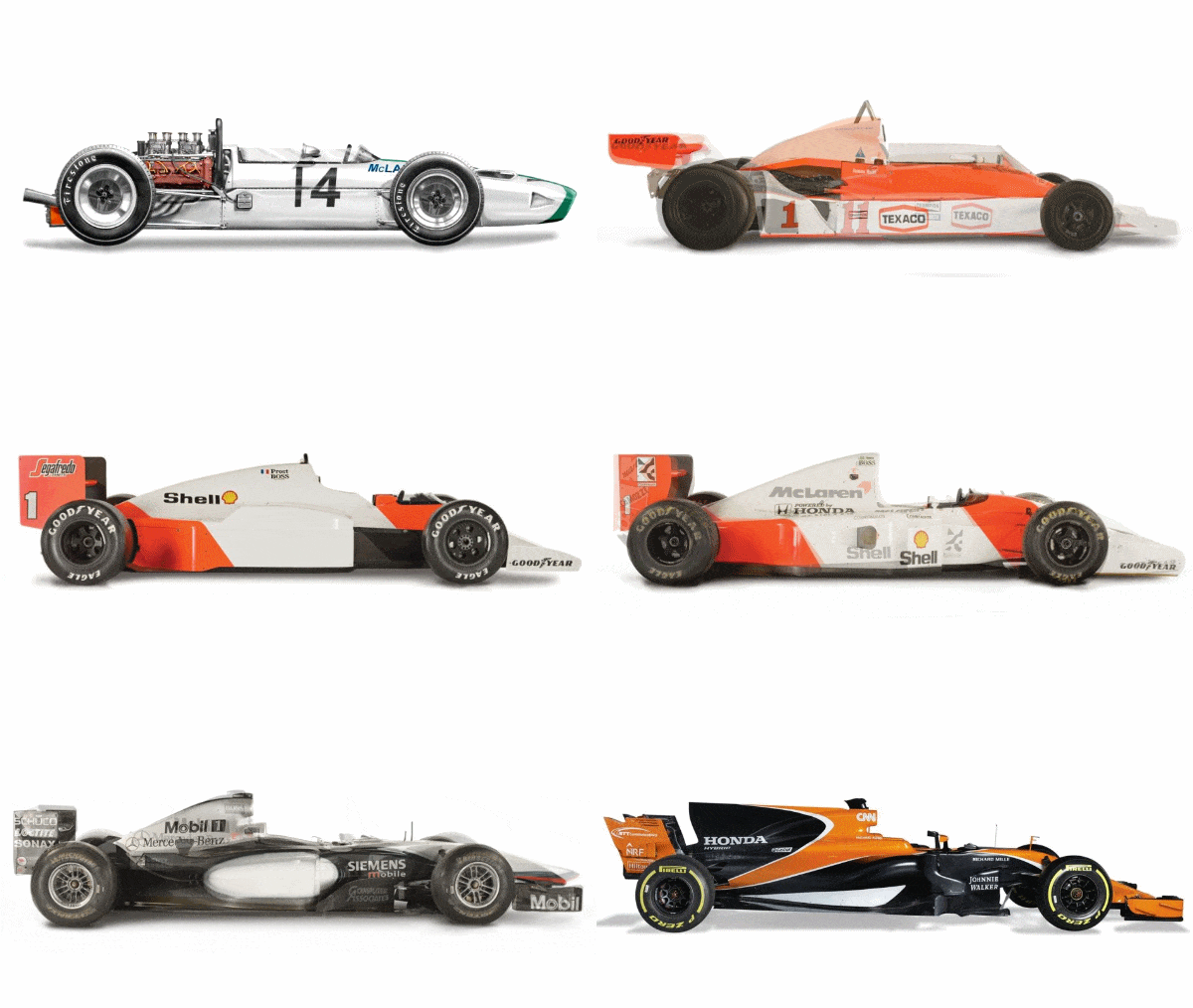
The very spine of the building is “The Boulevard,” on which dozens of historic McLaren Formula One cars are parked, nose out, in chronological order. The collection represents a veritable chronology of Formula One innovations that illustrate how McLaren has advanced the art of racing through history, particularly in the area of aerodynamics. The cars on the boulevard are all runners, McLaren says, and are occasionally shown off at vintage car events and/or media programs. Most sit atop a what looks like a cookie sheet on the floor—carbon fiber, of course—to collect any fluids that might find their way out. All were spotless, of course. (We checked.) On the other side of the glass wall is a reflecting pool full of water used to cool the wind tunnel.
(Yahoo.com)
McLaren is, first and foremost, a Formula One racing company that also happens to build road cars. So named after company founder and racing legend Bruce McLaren, who died in a trackside mishap nearly a half-century ago, McLaren earned its bona fides as a Formula One racing superpower ever since. Making it onto bedroom posters is nice, but no mistake, making racing cars is job one.
The McLaren grounds are awash in history, particularly inside the yin-yang-shaped headquarters, called the Technology Center, which houses the Formula 1 Racing Team, McLaren Applied Technologies, McLaren Automotive (the car-building arm), and the McLaren Technology Group. Built in 2010, the glass-and-steel architectural gemstone contains McLaren’s corporate offices, a wind tunnel, a gym for employees, another gym for the F1 team, a swank cafe, and a trophy case half the length of a football field.
McLaren’s F1 cars are built right there in the Tech Center—in plain view—by Hugo Boss-clad engineers, so access to its grounds is only granted to a privileged few: high-rolling customers, members of McLaren’s own F1 race team, and McLaren employees. Rarely, McLaren invites Formula 1 fan clubs and similar groups to open houses, but McLaren certainly wouldn’t want members of, say, the Ferrari team poking their noses around unattended (even after some recent disappointments.)
The very spine of the building is “The Boulevard,” on which dozens of historic McLaren Formula One cars are parked, nose out, in chronological order. The collection represents a veritable chronology of Formula One innovations that illustrate how McLaren has advanced the art of racing through history, particularly in the area of aerodynamics. The cars on the boulevard are all runners, McLaren says, and are occasionally shown off at vintage car events and/or media programs. Most sit atop a what looks like a cookie sheet on the floor—carbon fiber, of course—to collect any fluids that might find their way out. All were spotless, of course. (We checked.) On the other side of the glass wall is a reflecting pool full of water used to cool the wind tunnel.
(Yahoo.com)
Subscribe to:
Posts (Atom)