Showing posts with label engines. Show all posts

Wednesday, August 15, 2018

Monday, August 6, 2018

Such A Powerful Punch From Only 1.5L Of Displacement


From 1984 to 1987, Porsche built a 1.5-liter turbocharged V6, branded as the TAG-Porsche TTE P01, for the McLaren MP4/2 and MP4/3; if the naming seems odd to cover four years, it's because McLaren raced the MP4/2B and MP4/2C in 1985 and 1986. The engine produced more than 1,000 horsepower in qualifying trim, and 750 hp in race spec.

(AutoBlog.com)

Monday, July 30, 2018

That's About $19 Per HP To Start, $29 Per HP With Add Ons

Here's What A $17,000 Four-Cylinder Engine Sounds Like

You do get a lot for your money, with an engine taken up to 2.3 liters from 2.0 and the aforementioned 900 horsepower.


This package offers a complete performance engine build from Mazworx, using the SR20 platform.

Final displacement is 2.3L and this package is rated for over 900hp and the constant abuse on drift engines.

We start the build reinforcing the block with the installation of Darton sleeves. Then we complete block preparation, constantly taking measurements to ensure the correct machining process is used.

As for the cylinder head, we start with a Mazworx Stage 3 CNC Porting, installation of new guides, valve angle job, lashing.

For the completion of the Long Block, Mazworx degrees and put it together using Mazworx Head Gasket and new hardware.

Basic setup starts with:
  • Mazworx 91mm stroker crankshaft
  • Custom CP Pistons
  • Carrillo Rods (machined to accept 19mm bearings)
  • Calico Coated ACL Race Bearings
  • Mazworx 1/2" Head Studs
  • Mazworx Billet Main Caps and 1/2" Main Studs
  • Mazworx Full Grommet Headgasket
  • Supertech Valvetrain + Mazworx Shimless valves setup
  • Kelford Cams with VVL killer
  • Tomei Adjustable Cam Gears
  • Mazworx Timing chain kit
  • Nissan OEM Oil Pump

Options:
  • Add 90mm Ross Throttle Body / add $325.00
  • Add Complete Cooling System / add $815.00
  • Add Mazworx Catch/Air-Oil Separator Can Kit / add $395.00
  • Add Mazworx Hall Sensor Kit / add $449.00
  • Add Mazworx SR20 Conversion Intake Manifold with ID Injectors / add $2,055.00
  • Add Mazworx/Garrett Turbo Kit (rated to 750+hp) / add $4,429.00
(Jalopnik.com)

Thursday, December 21, 2017

There's Some Truth To This

Buy The Naturally Aspirated Performance Cars

These newer turbo engines are good, for sure, but most of them feel the same. They often sound the same. They deliver power much the same, linearly and without the insane drama and violence they used to. They’re a bit boring. I drive a lot of cars—they pay me to do this, for some reason—and so many of these new turbo sixes and fours just feel indistinguishable from one another. Good, but... the same.

What have we lost? Character. Different kinds of noises. In some cases, noises at all—the kind that don’t have to be piped in through speakers. Revving. Glorious, glorious revving. Having to work for speed rather than letting it come easy.

This is the way things will continue to go. Engines will increasingly have forced induction, then be more and more hybridized before going full-on electric. This is fine. Perhaps these engines will deliver on that promise of reduced emissions. This is likely the way things need to go for future generations. My desire for a better tomorrow outweighs my sadness over the loss of traditional engines.

But! While we still can—while you still can—buy the naturally aspirated engines. There are fewer and fewer of them every year. They’re dying off or going turbo. We must celebrate and enjoy them while they last.

Go out and buy an NA car. Enjoy the sound. Enjoy the revs. Enjoy the power delivery. Enjoy internal combustion the way it was meant to be, while you can.

(Jalopnik.com)

Tuesday, November 28, 2017

It Had A Good Run, But It's Usefulness Has Passed

Insight: Is it time to give up on the diesel engine?

Once we were all encouraged to buy diesel-engined cars, but now they are being ostracised because of health concerns. So, should we desert diesel? 


Finding the correct answers to these burning questions seems to be clouding more and more car purchase decisions. There are supporters for each of the above courses of action – but the arguments for banning diesels are becoming ever more shrill, led notably by Sunday newspapers quoting doctors’ organisations and academic sources in support of their case, and diesel sales are falling as a result.

The industry’s view is multi-faceted and complex. First, while carefully admitting ‘more can always be done’, its experts believe that when current, tough Euro 6 (EU6) emissions standards are combined with much more realistic and impartial test regimes that arrive this September (called WLTP or Worldwide harmonised Light vehicles Test Procedure), a modern car’s output of NOx will have been cut to tiny proportions. Diesels should be free to get right on with their job of contributing to lower CO2.

Second, the automotive industry is understandably reluctant to criticise the cars it has already put on the road, on the grounds that they complied with the legislation of the time. UK car users have bought roughly a million diesels per year and there are an estimated 12m diesel cars and vans already on our roads. Penalising them would create havoc. Completely changing the car parc, if you started now, could take 20 years.

Third, Europe’s motor industry needs to preserve its markets, viability and infrastructure to fund new, electrified cars planned along its ‘glidepath’ towards the 95g/km manufacturer fleet average that's required by 2020 – and onward towards a hoped-for zero-emissions future in 2050. (In the UK, Jaguar Land Rover has just opened a new diesel plant in Wolverhampton and Ford builds most of its world requirement for diesels in Dunton).

Fourth, its bosses are extremely reluctant to wade into a complex, illogical debate that has conflated Volkswagen’s highly publicised diesel emissions scandal in the US with a 15-year-old progression of EU emissions standards – currently at EU6 – whose fuel consumption results bear so little resemblance to owners’ experience that they are presumed to be dishonest. ‘They’re all at it’ is the common accusation.

The most urgent problem, identified by London mayor Khan, appears to be the profusion of old-school diesels – notably, well-worn and decades-old taxis, trucks and delivery vans as well as passenger cars – on our roads. The mayor has already hit the headlines, and been rebuffed by the government, for proposing a £500m scrappage scheme that would pay diesel owners up to £3500 for ditching old diesel cars.

(AutoCar.co.uk)

Wednesday, October 25, 2017

Not Really, Because Someone Just Had To Have It

Paying $10,000 For A Bugatti Chiron Model Engine Seems Rather Silly

Life is full of silly things, a lot of which would be cool if they weren’t so silly. Take this model of a Bugatti Chiron engine: It’d be a great conversation piece on your LED-backlit display wall of rare, expensive automotive memorabilia dusted with diamonds for extra shine, but maybe not for $10,000.

Then again, if a display wall dusted with diamonds is your kind of thing, maybe a starting price of $9,365 for this model isn’t a big deal.
Personal feelings about the worth of material objects serving no purpose other than to look at aside, this 1:4 scale of a Bugatti Chiron engine and gearbox is pretty mesmerizing. The company that makes it and other expensive vehicle replicas, Amalgam Collection, said there are 1,040 individual parts and all of the special finishes Bugatti puts on the actual car’s 1,500-horsepower W16 engine packed into a model that’s only 18 inches long and 9 inches high. 

(Jalopnik.com)

There's No Replacement For Displacement (Yet) For Lamborghini

Lamborghini will keep naturally aspirated V10 and V12 engines as long as it can

Maurizio Reggiani, development boss of Lamborghini, further explained to Autocar that the naturally aspirated V10 and V12 engines on models like the Huracan and Aventador will remain for quite some time, and they mean for as long as possible. So don’t expect to see these models to have newer and smaller engines anytime soon, or as long as Reggiani is the development boss. He then says that it provides “a sense of emotion in a super-sports car”.

Reggiani once said that a Lamborghini’s DNA is made up of design, emotion and performance – elements that define a new car. The company then puts these elements in a scientific way by making them physical things so that the new cars can be compared to an old one, or perhaps, its competitors. Other factors that matter include sound, speed, acceleration and design.

(4WheelsNews.com)

Monday, May 8, 2017

25 Years Of Age Defying Performance Gains

Here's Why The Toyota Supra's 2JZ Is Such A Legendary Engine

Tuner Potential

From the factory, the 2JZ-GTE is already a pretty special engine. It’s got dual overhead camshafts, four valves per cylinder, a distributor-less ignition system, liquid-cooled sequential turbos keeping the power band nice and broad, and a “square” (one to one) bore-to-stroke ratio that provided a great compromise between low-end grunt and high-end power. Start tuning it, though, and the engine goes from “special” to downright supernatural.

The reason why the 2JZ-GTE is so prolific in the tuning scene is because of its strength. Its iron block is tough as nails, its seven main bearings—despite only being held by two bolts each—are absolutely gargantuan and hold the crankshaft firmly, its forged 12-counterweight steel crankshaft can handle huge power and high engine speeds, the oil pump and water pump can take the heavy mods without failure, the fully-closed deck means the engine can withstand enormous cylinder pressures, forged connecting rods are stout, and the oil-cooled cast aluminum pistons can handle a beating as well.

Power Without Limit

Getting there isn’t really that difficult, either. Though there are a couple big-bore and stroker kits out there, most high-horsepower 2JZ-GTEs get that grunt by way of changing out the intake and exhaust, swapping those sequential turbos out for an enormous single turbo (67mm is common), installing a bigger front-mount intercooler, and bolting on some bigger injectors and fuel lines.

It was an advanced engine in its day, and for 1998, it became even more so, as the Japanese version got variable valve timing. Sadly, the U.S. market got nothing, and ’98 was the final model year for the legendary 2JZ-GTE in the U.S.

But despite its short run here, the 2JZ-GTE remains a crown jewel in the tuner community, with Supras and 2JZ-swapped anything else continually winning drag races and whatever else they’re called to do.

Even 25 years after its debut, the 2JZ-GTE continues to decimate all.

(Jalopnik.com)

Tuesday, February 7, 2017

I Would Like To See This Dyno In Action

The Bugatti Chiron Is Tested On The Most Powerful Dyno In The World

In order to test the Chiron’s 1,500 horsepower and 1,180 lb-ft of torque engine, Bugatti installed the most powerful dynamometer in the world. When the Chiron is tested, it produces 1,200 amps of electricity that is fed back into the power grid.

(Jalopnik.com)

Monday, February 6, 2017

This Is Quite A Hual

Thieves stole $3.7 million worth of Jaguar Land Rover engines 
 
And this isn't the first time theives have pulled off this sort of heist.

This past Tuesday was not a good one for Jaguar Land Rover. According to British news source Birmingham Mail, just over $3.7 million worth of engines were stolen from the company's factory in Solihull, England. Reportedly, the thieves drove up to the facility in a stolen semi-truck, found a trailer full of engines, hooked it up, and drove off. The thieves did this twice in one night, with the same truck, and got the first trailer in just six minutes.

Perhaps more shocking is that Birmingham Mail reports this is the second time a theft of this type has occurred at the facility. The previous time happened in almost exactly the same way, but the engines taken were valued at just over $1.2 million, and five people were convicted of the crime. Currently, local police are looking for the latest suspects and the engines. The trailers were found, but were empty.

(AutoBlog.com)

Thursday, February 2, 2017

6th Senses

V6 Vs Straight-Six: The Pros And Cons

Six-cylinder engines have nestled within some of the greatest cars of all time, so how does the V-format compare to the in-line alternative?

Straight six advantages

Firstly, like any in-line engine, straight sixes are a nice, simple design. With no cylinder offset, manufacturing costs are low and there is no need for separate heads or valvetrains like in a V-configuration. Instead of using double the amount of smaller camshafts, a DOHC I6 can simply use two longer camshafts to open and close its valves.

The simplicity of these engines is emphasised also when it comes to working on them, with the straight configuration allowing great access to all the spark plugs, leads and ancillaries for general maintanence, making the I6 an amateur mechanic’s friend.

Straight-six disadvantages

Unfortunately, there are numerous reasons why the straight six is all but dead. Packaging has always been an issue, as the extra two cylinders when compared to an I4 means that mounting the engine in a transverse configuration is very difficult. If mounted sideways, there usually isn’t enough room for the size of transmission and drivetrain needed to use an I6 in a front-wheel drive setup. And with manufacturers looking to create powertrains that can be shared across as many chassis as possible, the elongated I6 just doesn’t quite cut it.

V6 advantages

Due to its much more stocky, compact nature, it is capable of being shoehorned into numerous engine bays within a manufacturer’s fleet, thus cutting huge costs from having to perform R&D on other engine options.

V6 disadvantages

Although it may feature the same number of cylinders as its in-line brother, the V6 does not have the same intrinsic balance. Effectively made up of two in-line three-cylinders stuck together, the V-style engine needs balancing shafts that use specially placed weights to counteract the unwanted inertia created by the reciprocating engine. Without these balancing shafts, large vibrations would travel through the crankshaft and offset the efficiency of the reciprocation.

The engine balance is worsened as displacement increases (longer piston stroke) and an increase in bore size (increasing the mass of the piston). The counterweights needed therefore add complexity to the engine’s design and manufacture, increasing overall costs. Naturally a DOHC V6 must have four camshafts and potentially 24 valves in total, so the complexity of the additional valvetrain components needed to fill each cylinder head further increases the complexity of this engine setup which can make working on V6s an intimidating prospect for a less-experienced petrolhead.

(CarThrottle.com)

Wednesday, February 1, 2017

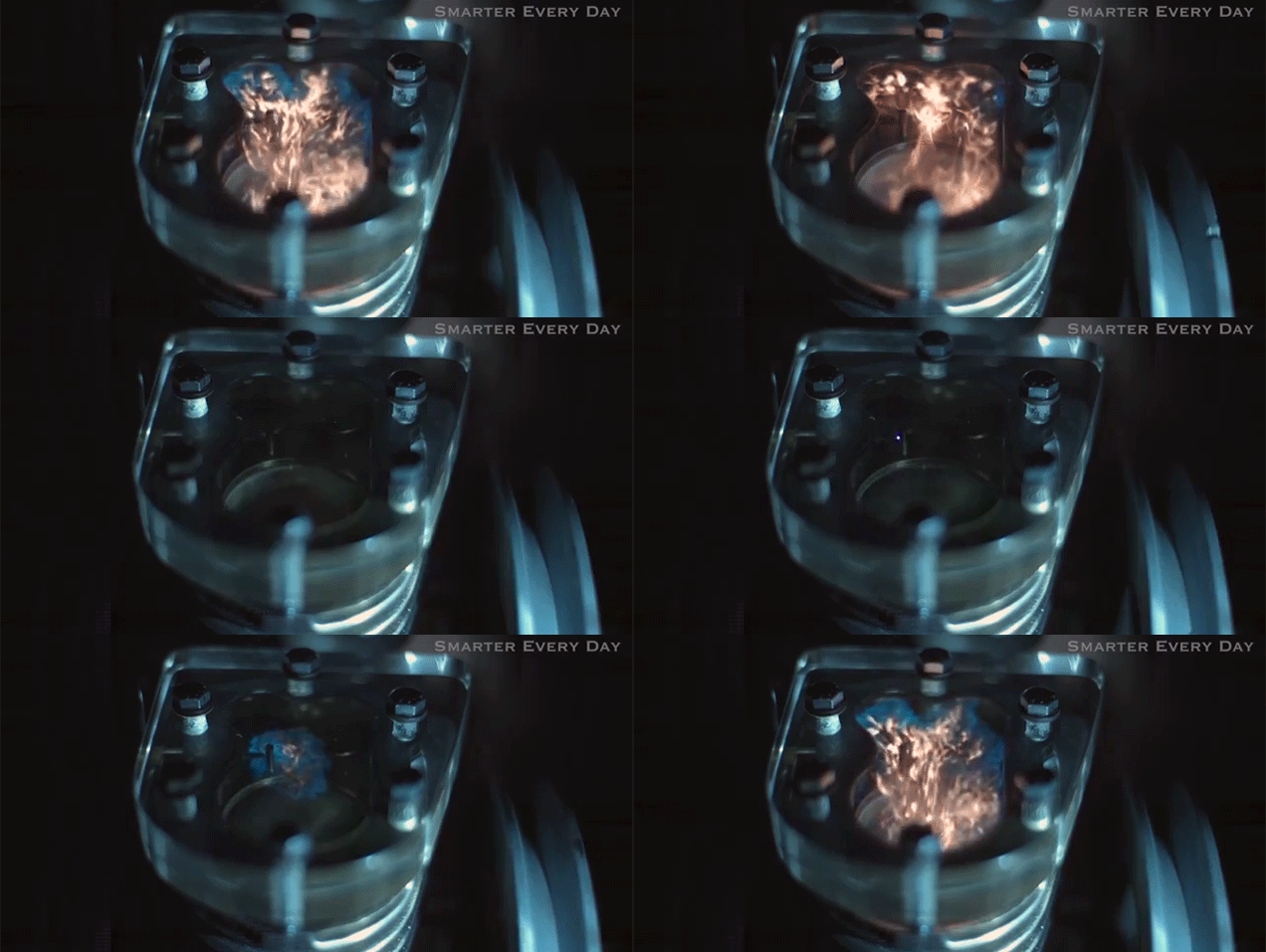
Fire In The Hole!

Seeing the Explosion Inside a See Through Engine Shows You How Engines Work


(Gizmodo.com)

Tuesday, January 17, 2017

And They're All Really Sound Reasons

5 Reasons Why You Can't Put An F1 Engine In A Road Car

It would be an incredible feat of engineering to shoehorn an F1 engine into a road car, but the logistics behind this form of engine swap just wouldn't match up
  1. They are notoriously difficult to start
  2. They're not cheap
  3. Cooling
  4. That fuel bill though
  5. The lifespan is tiny
(CarThrottle.com)

Friday, December 2, 2016

These Are Some Bad Lil' 4 Bangers

20 of the Best-Sounding 4-Cylinder Engines Prove You Don’t Need a V8

Toyota 3S GTE
  • Found in: Celica, MR2, Caldina
  • Toyota S engines have always been reliable choices no matter the application in which they were found. 3S GTE, however, was more than that. Normally aspirated and turbo 2.0L I4 made an appearance in the likes of 3rd, 4th and 5th gen Celica, and 2nd and 3rd gen MR2. It produced anything from 182 hp in Celica ST165 to 252 hp in MR2 ST205. And that sound!
Nissan SR20DET
  • Found in: Nissan Silvia
  • Nissan’s 2.0L turbocharged DOHC I4 with the electronic fuel injection has made its home in numerous Nissans including Pulsar, Sunny, and most notably Silvia. S13, S14 and S15 Nissan Silvia used to make between 202 hp and 250 hp thanks to it. It wasn’t only powerful, but loud as well. SR20DET isn’t one of the best-sounding 4-cylinder engines for nothing, after all.
BMW S14
  • Found in: BMW M3 (E30)
  • Few of you will remember that the original M3 actually had the 4-cylinder engine. Straight-four was available throughout the entire first generation, and it practically created the M badge. It was offered in two displacement groups: 2.3L and 2.5L. Former delivered between 197 and 217 ponies while the latter produced 235 horsepower. Although sufficient for the original M compact sports car, 4-cylinder setup was abandoned in favor of the 6-cylinder layout in second generation M3.
Complete list (GearHeads.org)

Monday, September 26, 2016

You Were Never Given A Chance

Audi kills off its 420-hp four-cylinder engine project 

Germans dump their giant-killing 2.0-liter concept motor

Audi's supercar-slapping, fire-breathing four-cylinder concept engine will remain just that, with Autoblog confirming that it has been internally killed off. Speaking at the launch of the TT RS, the engineering boss of Audi's Quattro GmbH division, Stephan Reil, said the Volkswagen Group had stopped all development of the 420-horsepower, 2.0-liter four it showed in the 2014 TT Quattro Sport Concept car (above).

Despite previous assurances that Quattro had roles for both the EA888-based engine and Audi's wildly charismatic 2.5-liter, five-cylinder motor, post-Dieselgate reality has killed the smaller engine. "The 400-horsepower EA888 engine is dead," Reil said.

(AutoBlog.com)

Monday, August 15, 2016

Did You Know - Koenigsegg Agera RS Edition

The amazing geeky details of the Koenigsegg Agera RS engine

Koenigsegg has been running a series of posts about how the company designs and assembles the Agera RS. It turns out that even the little engineering details of the Agera RS engine are pretty fascinating, as Koenigsegg recently revealed in a new in-depth look at the 1,160 horsepower engine.

For instance, many other companies add various extra rings and other complexity to their high horsepower engines, but Koenigsegg says that the block and heads are so stiff, the company can use much more basic gaskets. Apparently this adds to long-term reliability since simple head gaskets can handle more heat cycles.

The company also talks about how it creates a more effective catalytic converter system to make such a monstrous engine meet strict emissions standards. To do this, two converters are used. One small one after the turbo wastegate, and a short one with a wide diameter in the main exhaust pipe. At start-up, exhaust is sent only through the wastegate where the small cat heats up fast. This way emissions can be kept low while the main cat is still below operating temperature. This also allows the use of the short, wide cat in the main pipe, which keeps the exhaust free-flowing and the engine making as much power as possible.

(AutoBlog.com)